




How to Lay Out Rugs at Home: Practical Tips for a Stylish and Well-Planned Arrangement
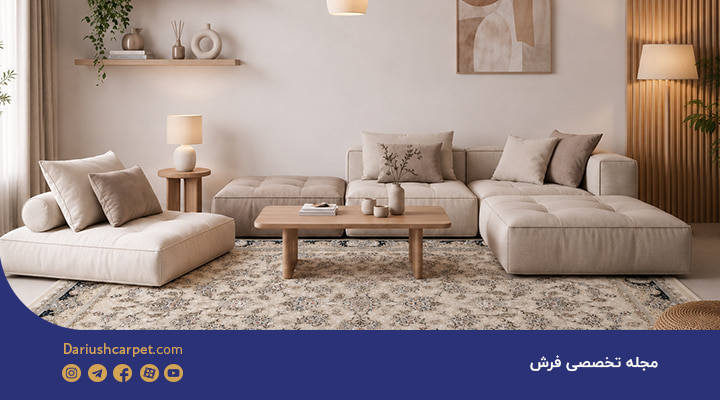
The way a rug is laid out and positioned in the home significantly influences the beauty, order, and overall aesthetic of the interior décor. In recent years, the expansion of urban living and the rise of apartment-style housing have transformed home styling trends. Unlike in the past, homes are no longer fully carpeted from wall to wall, and the approach to floor coverage has evolved.
Today, selecting a rug involves more than just considering its design, color, and size; the placement of the rug within the home is equally important. Factors such as where the rug is positioned, its distance from the walls, and how it relates to furniture, tables, beds, and other items can profoundly impact the visual appeal of the living space.
To learn more about the role of rugs in home décor and how to best showcase their beauty within your living space, stay with Dariush Carpet Magazine through the end of this article.
How does lifestyle influence the way rugs are arranged in the home?
The way rugs are used in a home is directly linked to the residents' lifestyle. One cannot equate the lifestyle of a small apartment with that of a large detached house and apply the same formula to both.
How to Lay a Carpet in a Classic Home Layout
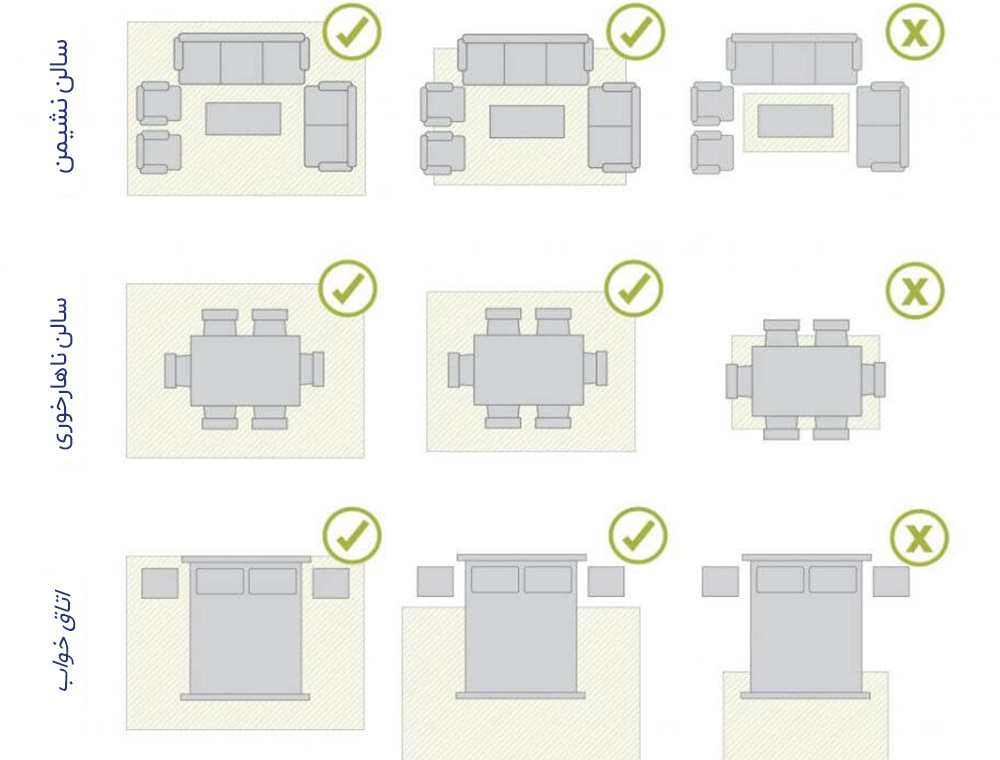
In a classic layout, the carpet typically covers a significant portion of the room, and the furniture is placed upon it. While the legs of the sofa may rest on the carpet, it is preferable to maintain some space between the carpet and the living room walls.
In this arrangement, the carpet plays a central role in floor coverage, and various décor elements relate directly to it.
Modern Approaches to Placing Rugs at Home
In modern interior design, a rug does not necessarily cover the entire floor area of the room. Often, the rug covers only the central section—typically about two-thirds of the room's middle space.
In this style, furniture legs do not have to rest on the rug; instead, the rug may simply define the seating area and the surrounding circulation space.
Modern layouts also allow for the use of round or oval rugs to add variety to the interior. Choosing these shapes—especially when they harmonize with the room's dimensions and layout—can give the home a distinctive look.
How to Position a Rug in the Living Area of a Small Apartment
In small apartments, there is often no clear boundary between the formal reception area and the casual living area; the entire space may be designed as a single, open-plan room.
In such cases, it is best to use a rug of the appropriate size. You can place the rug in the center of the room, position the coffee table in the middle of the rug, and arrange the furniture around it.
The rug should not be so large that it covers the entire floor area. It is also advisable to leave a gap of about 20 to 30 centimeters between the rug and the walls.
Using Two Rugs to Separate the Formal Reception and Casual Living Areas
If the apartment is spacious enough to accommodate two rugs in the main living area, they can be used to define distinct zones.
For instance, one section of the room can serve as the formal reception area, while the other functions as a casual living space.
A medium-sized rug (approximately six square meters) is suitable for the reception area. Ideally, the furniture legs need not rest entirely on the rug; instead, the rug’s surface should primarily facilitate movement and provide a comfortable spot for guests to sit.
In the other section of the room—designated as the living area—a smaller rug can be placed alongside a two-seater sofa. This arrangement creates a cozy setting perfect for watching television, enjoying tea, and relaxing.
Using Rugs to Define Different Areas of the Home
Rugs can serve as an effective tool for delineating various sections of a home.
This applies to the dining area as well. If you are using both a seating area and a dining set within a small space, it is best to separate each zone with its own dedicated rug.
Placing two seating groups—or a seating area and a dining set—on a single rug, or even arranging them around one large rug, can blur the boundaries between these different areas.
Therefore, by selecting rugs of the appropriate size, you can distinguish between different parts of the home and create a more organized space.
How to Lay a Rug in the Bedroom
The way a rug is placed in the bedroom differs from how one selects and lays a rug in the living room. Particularly in small apartments where bedroom space is limited, it is not strictly necessary to cover the entire floor with a rug.
In a typical layout, the bed is positioned perpendicular to the rug; the rug is laid across the room, and the bed sits upon it.
In this arrangement, approximately two-thirds of the rug can be placed under the bed, leaving one-third exposed so that your feet land on the rug when you get out of bed.
You can also use two runner rugs—one on each side of the bed. Additionally, a small rug or runner can be placed at the foot of the bed to provide a comfortable spot for your feet upon waking.
Using Rugs to Create a Child's Space in Small Homes
In small homes and one-bedroom apartments where children lack a separate room, a dedicated space for the child can be created using a child-friendly rug and a partition.
To achieve this, place the child's rug in a corner of the room and position the bed within that same area. This approach allows for the creation of a distinct, private zone for the child, even in a limited space.
This method mirrors the concept often used to separate formal living areas from casual family rooms; essentially, rather than erecting permanent walls, one can use rugs, furniture, and decorative elements to delineate different sections of the home.
Using carpets of different dimensions for cost management
For cost management, carpets of different sizes can be used for the home. For adult bedrooms, you can also use a small round rug in front of the bed.
To make the house more beautiful, it is not always necessary to cover all the spaces with large and expensive carpets. Smart selection of dimensions and layout can also be effective in cost management.
Conclusion
Laying out rugs in your home involves more than just selecting a beautiful piece. Factors such as the size of the home, room dimensions, lifestyle, furniture type, and the function of each area all influence the choice of rug and its placement.
In smaller homes, the strategic use of appropriately sized rugs and runners can help define spaces and create a sense of order. In larger homes or villas, classic or modern layouts can be employed to create a distinctive atmosphere.
In the bedroom, you might use a combination of area rugs and runners, while in the kitchen, it is best to position rugs so they do not extend underneath the cabinetry.
Budget management is also a key part of the decision-making process. Creating a beautiful home does not necessarily require using the most expensive rugs in every area; the right choice of size, design, quantity, and placement can yield excellent results.
Ultimately, the way rugs are arranged should harmonize with the home's layout and the residents' lifestyle. Beyond adding beauty, rugs help delineate different areas of the home, fostering an environment that is organized, warm, and inviting.
Remember, for many of us, the home is a sanctuary for relaxation and peace. Therefore, selecting the right rug and carefully considering its placement plays a vital role in creating the ideal home atmosphere.
At the Dariush Carpet Group, we offer a range of rugs tailored to the diverse styles and needs of Iranian homes. If you have any questions or uncertainties regarding the selection and purchase of a suitable carpet, you can call 09139992039 to receive a free consultation.